Halloween Music to Die For: The Show Went On | Solitaire Clash Spookitaire Cold Case
Game Events Nov 13, 2026
Music usually sets the mood. It can make a moment feel exciting, dramatic, or, on Halloween night, just the right amount of spooky. But at Ashgrove Concert Hall, the Halloween music was only the beginning of a much stranger night.It was the hall’s annual Halloween concert, with Danse Macabre set to close the show. According to the legend behind the piece, the dead rise from their graves at midnight and dance until dawn. Perfect Halloween material, right? Well, this particular performance was about to get a little too close to its theme.Before the curtain went up, Detective Paws and Chief Humphrey headed backstage after receiving an invitation from artistic director Victor Halloway. What should have been a quick pre-show visit soon turned into The Show Went On, the first mystery in Spookitaire: Cold Case from Solitaire Clash by AviaGames.If you’ve been following the case on the Solitaire Clash Facebook page, you’ve had a week to study the clues, question the suspects, and come up with your own theory. Haven’t seen the clues yet? You might want to take a quick look before reading on.Got your suspect? Good. Let’s see if you were right.
What Happened at Ashgrove Concert Hall?
Before we start pointing fingers, let’s rewind to the beginning of the night.Three people backstage quickly stood out:
- Adrian Voss: The orchestra’s young viola star, who signed an autograph before heading to Practice Room 2
- Nadia Sorel: The first violinist, who clearly wasn’t happy with Halloway
- Peter Lund: The stage manager of 20 years, who had keys to every door backstage
Halloween Music With a Killer Twist: The Full Story
Three years ago, at the international viola competition, Adrian Voss knew the final repertoire before anyone else did.He had eight weeks with it. He played it until he could play it with his eyes closed. Every other competitor received the score seventy-two hours before the final. He won cleanly, and the applause, the contracts, the principal-level chair — all of it followed.For three years he had all but forgotten about it. Then, this past summer, one of the judges from that panel put the whole thing in writing and sent it to Ashgrove Concert Hall.Victor Halloway spent three months verifying it. He was not a man who enjoyed digging up old business, but he was a man who said things to your face. He intended to hand Voss the file on the night of the Halloween concert, and give him the chance to withdraw on his own terms.The file was in his briefcase. That week he did one more thing: he posted two invitations to the concert, one to the detective and one to the officer. He meant to hand the file over after the performance, and it was not the kind of thing he wanted to do alone in a room. He wanted witnesses — preferably the kind with a badge.That afternoon, Voss arrived an hour and a half early.He did not practice. He did something more useful in Practice Room 2: he fed a recording he had made the day before into the room's speakers and set it to loop. On the tape, he played one Paganini passage twice through. He listened to all of it once. It seemed airtight.At seven-thirty, music began coming down the corridor. Two colleagues passed outside, heard it, and laughed — he's grinding that Paganini again.At the same moment, Voss came around the other way to the storage room.Halloway was already waiting, the briefcase open on a crate.The conversation did not last long. Halloway was direct about it, and decent about it — what he was offering was a way out, not a dead end. But Voss heard only one thing: that night three years ago had finally caught up with him.The C string in his pocket had come off his instrument three days earlier. Wire-wound. Thin. Extraordinarily tough. It went around his hand exactly one and a half times.Afterward, he did three things, each one calmer than the last.He wiped the string clean, re-coiled it into a small loop exactly as it had been, and slid it back into the pouch of old strings in his case. He took the file out of the briefcase. Then he walked out of the storage room, and the door swung shut behind him and locked with a click.He did not need a key. He never had.When he got back to the practice room, the recording was halfway through its second pass. He switched off the speakers, picked up his viola, and walked to the stage.At eight o'clock, the lights went down. Thirty-seven musicians in skull makeup walked on and played Danse Macabre to a full house. Voss sat in the second row of the viola section and played well — a great many people said afterward that he played better than they had ever heard him.Forty meters away, in the storage room, Halloway had been dead for forty minutes.The detective got stuck on the weapon.Backstage had been searched twice. Rope, cord, curtain pulls, bow hair — none of it matched a mark that thin and that clean. Then the medical examiner's report came back. There was rosin inside the ligature mark."Rosin only ends up on two things," he said to the officer. "A bow, and a string."The officer looked up. "So where is it now?""Exactly where it's been the whole time," the detective said. "We never treated it as a weapon. We treated it as a spare part."That morning, thirty-seven instrument cases were opened again. Spare-string pouches were emptied onto a long table, two hundred–odd used strings spread across it.One viola C string had been re-coiled. Wound the opposite way from the factory.The officer turned it over in his fingers for a long moment. "And that tells us what?""That whoever coiled it used their left hand."The detective took the program out of his pocket, turned to the signed page, and slid it across the table.As for the half hour of music — the engineers rendered the corridor recording as a waveform and laid the two passes on top of one another. They matched almost perfectly. There was exactly one difference: the page turn landed in the same position both times, within ten milliseconds."A person can't do that," the detective said. "A machine can."Voss was still holding his viola when they took him out. He was calm the whole way, and stopped only once, at the car, to look back at the poster beside the hall's front doors — a crowd of skeletons, dancing.In the legend, the skeletons have to be back in their graves by dawn.He got one extra night.
The Clues: Did You Catch Them All?
Now that we know what happened, it’s time to look at the evidence. Over the week, seven clues were revealed, each bringing us a little closer to the truth. Some cleared suspects, while others exposed details that didn’t really add up.Here are the seven clues that cracked the case:
- It Wasn’t a Rope: The thin, deep mark around Halloway’s neck didn’t match an ordinary rope or cord. Whatever killed him was much thinner.
- Rosin Changed Everything: Investigators found rosin dust inside the mark, pointing to a bowed instrument string. Suddenly, the orchestra itself became part of the investigation.
- The Key Was a Red Herring: Peter Lund had keys to every backstage door, which made him look suspicious at first. But the storage room had a spring lock, meaning the killer didn’t need a key to leave and lock the door behind them. Lund also had an alibi: more than 20 witnesses saw him onstage during the murder window. That ruled him out.
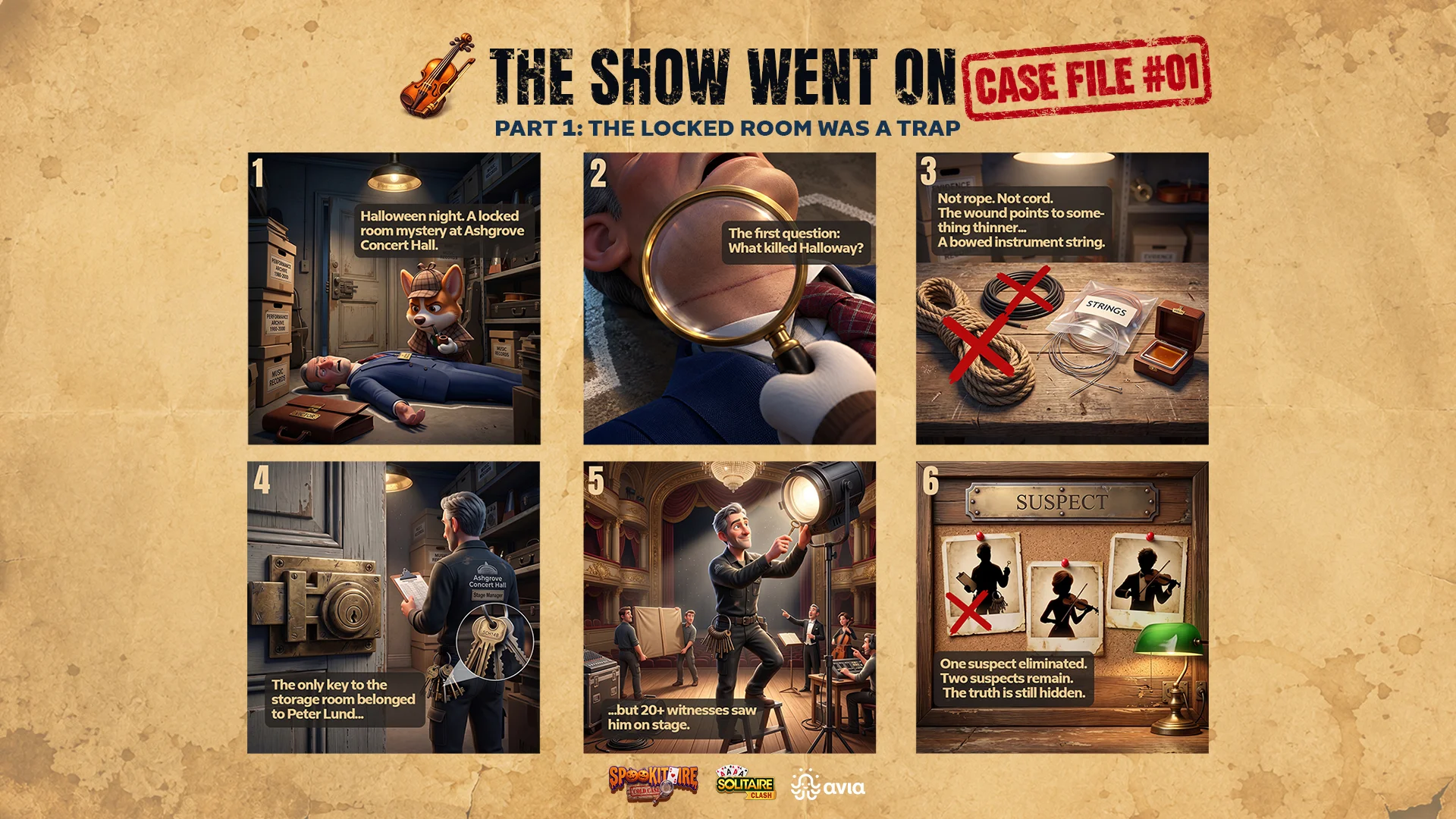
- Nadia Had an Alibi Too: Nadia Sorel had reason to be unhappy with Halloway, including problems with her contract. But during the entire murder window, she was with the wardrobe mistress. Her motive may have made her suspicious, but her alibi cleared her. Two suspects were now off the list.
- Voss Was Heard, Not Seen: Everyone thought Adrian Voss was practicing in Practice Room 2 because they could hear the same Paganini passage from the hallway. There was just one problem: nobody actually saw him inside.
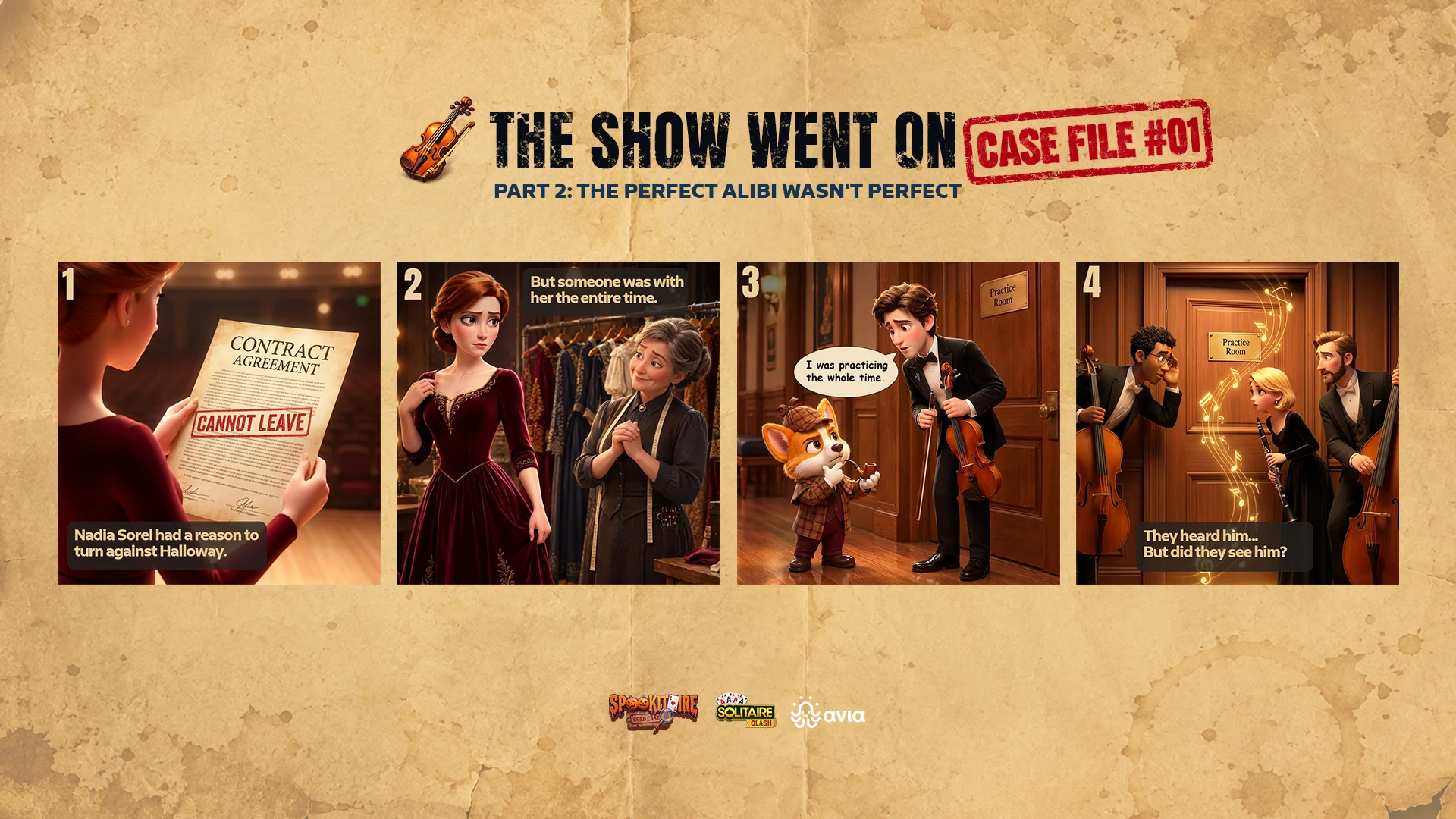
- The Music Was Too Perfect: Investigators compared the repeated Paganini performances and noticed the same page turn happened at almost exactly the same moment both times. That pointed to a recording, and Voss’s alibi started to fall apart.
- The Viola String: Investigators found a used viola C string in Voss’s spare-string pouch. It had been re-coiled in a way that suggested someone had done it left-handed. Remember the autograph Voss signed earlier? He signed it with his left hand.
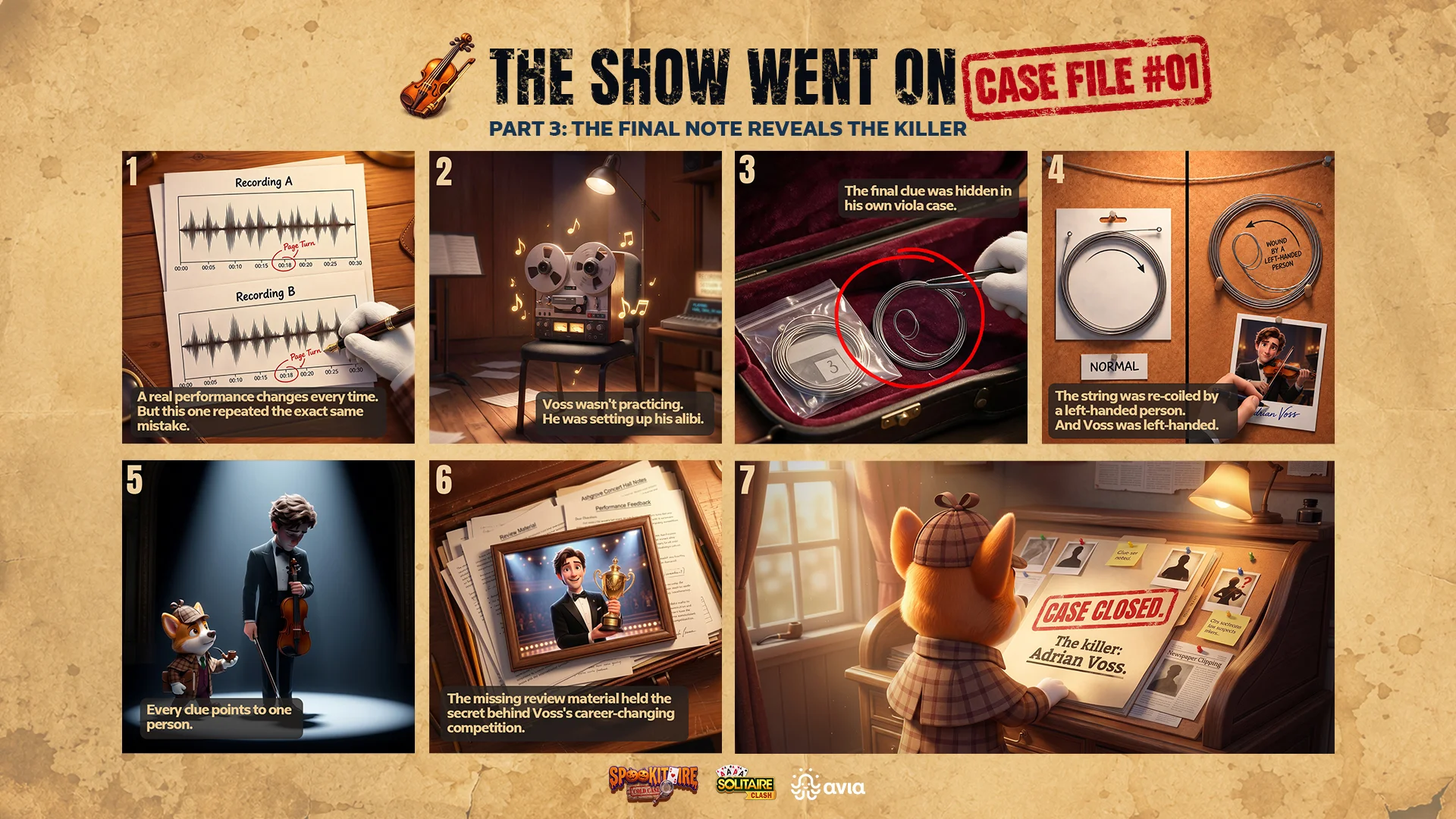
And just like that, all seven clues pointed toward the same person: Adrian Voss. But what was his motive? The answer went back three years and involved a secret that could threaten his career.
Why Did Adrian Voss Kill Victor Halloway?
Voss’s motive was tied to an international viola competition three years earlier. He had received the final repertoire eight weeks in advance, while the other competitors had only 72 hours to prepare.Voss won, and that victory helped launch his career.Years later, one of the competition judges revealed what had happened. Halloway spent three months verifying the story and, by Halloween night, was ready to confront Voss.The evidence was in Halloway’s briefcase. He planned to give Voss the opportunity to withdraw on his own terms and had invited Detective Paws and Chief Humphrey to be nearby as witnesses.Voss knew the secret behind his career was about to come out.So he decided to make sure Halloway never got the chance to reveal it.
How Did Voss Almost Get Away With It?
Voss’s plan depended on making everyone believe he was somewhere he wasn’t. Here’s how he pulled it off:
- He created an alibi. Voss arrived early and prepared a recording of himself playing the Paganini passage in Practice Room 2. At 7:30 p.m., the recording began playing, making anyone nearby think he was inside practicing.
- He met Halloway in the storage room. While the recording was played, Voss killed Halloway using a viola C string. He then wiped it clean, re-coiled it, and returned it to his spare-string pouch.
- He didn’t need the key. Voss simply left the storage room and pulled the door shut. The spring lock automatically locked behind him.
- He returned before showtime. Voss went back to Practice Room 2, stopped the recording, picked up his viola, and prepared to perform as if nothing had happened.
The Show Went On, but Spookitaire Isn’t Over
So, this concludes Case File #01: The Show Went On. What started as a Halloween concert ended with a recording, a viola string, and one small autograph exposing the truth behind Victor Halloway’s murder.But Solitaire Clash Spookitaire: Cold Case isn’t over yet. Next up is Case File #02: The Party of the Year, bringing a new mystery, new suspects, and a fresh set of clues to piece together.Follow the Solitaire Clash Official Facebook page for more clues as the next case unfolds. For fans of true crime stories, there’s another mystery waiting. Think you can solve it before the truth is revealed?Turns out, there’s more to this solitaire game app than cards. Download Solitaire Clash and join us for the next case!
1. Open your phone's camera
2. Scan the QR code above